Quality solar, battery, and energy systems
designed for the Thompson Okanagan.
Built with care. Installed with integrity.
Engineered to deliver clean power for
decades.
It's a question most people assume they already know the answer to. Summer is sunnier, so summer must be better - right?
The answer is more nuanced than it seems. And understanding it properly changes how you think about your solar panel system across the full year.
Do solar panels work better in summer or winter? In the Thompson-Okanagan, summer wins on production volume - but winter performance is stronger than most people expect, and the relationship between temperature and solar output might surprise you. Roost Solar has been installing and monitoring solar systems across the region since 2016, and seasonal performance is something we discuss with every homeowner we work with.
Here's the full picture.

The primary reason solar panels produce more electricity in summer comes down to two straightforward factors: longer days and more direct sunlight.
In the Thompson-Okanagan, summer days can bring 15 or more hours of daylight. More daylight hours means more time for your panels to generate electricity - even accounting for the lower-angle morning and evening sun. Combined with generally clearer skies and higher sun angles that put panels closer to their peak output, summer months deliver the highest production of the year for most systems in the region.
May through September is typically the strongest production window for Thompson-Okanagan solar systems. July and August often represent the peak months, with long days, minimal cloud cover, and the sun reaching its highest point in the sky.
This seasonal peak is exactly why BC Hydro's net metering program is structured the way it is - summer surplus credits bank up and draw down through the lower-production winter months, smoothing the seasonal difference across your annual bill.
Here's the part that surprises most people: solar panels actually operate more efficiently in cold temperatures than in hot ones.
Solar panels are semiconductor devices, and like most semiconductors, they perform better when cool. High temperatures cause increased electrical resistance inside the panel, which reduces output relative to what the panel could theoretically produce. This effect is measured as a temperature coefficient, expressed as a percentage output loss per degree Celsius above the panel's rated test temperature.
A typical solar panel might have a temperature coefficient of around -0.35% per degree Celsius. On a hot summer afternoon when panels can reach 60-70 degrees Celsius on a dark roof surface, this temperature penalty can meaningfully reduce output below what the panel's rated wattage would suggest.
On a clear, cold winter day, the opposite applies. Panels running at 0-10 degrees Celsius are operating well below their rated test temperature, which means they're actually producing closer to - or in some cases slightly above - their rated output per hour of sunlight.
A bright February day in Vernon, with fresh snow on the ground reflecting additional light onto the panels and cool temperatures keeping the cells efficient, can produce more energy per hour of sun than a sweltering August afternoon. The winter day just has far fewer hours of that sun to work with.
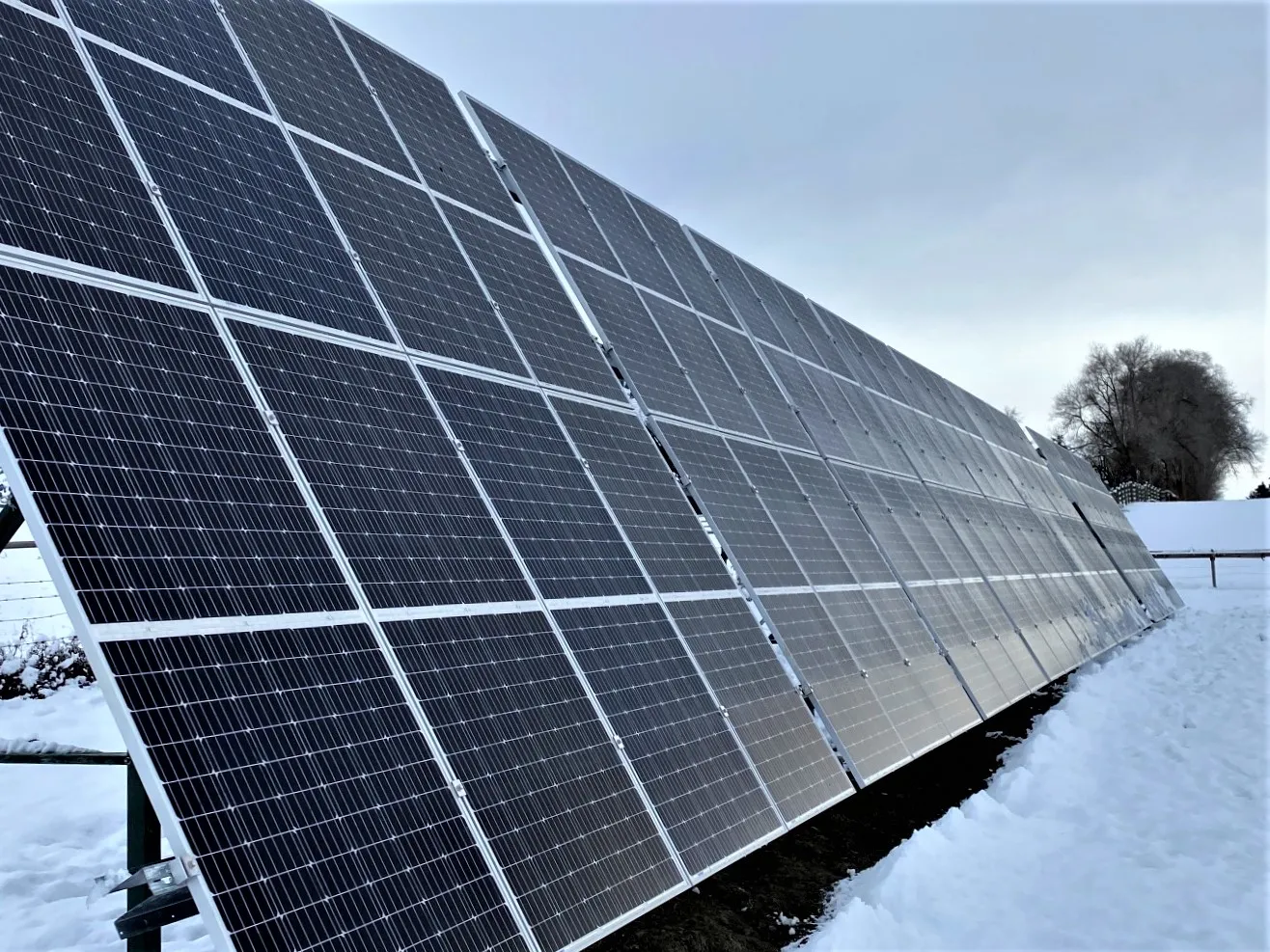
The biggest practical challenge for solar panels in winter isn't cold temperatures or reduced sun angles - it's snow accumulation on the panels themselves.
Snow sitting on a panel surface blocks light from reaching the cells, which reduces output far more significantly than cloud cover or low sun angles. A panel fully covered in snow is essentially not producing.
The good news is that panels are typically installed at a tilt angle that encourages snow to slide off on its own, and dark panel surfaces absorb heat quickly once any sunlight reaches them - accelerating snow clearing. In the Thompson-Okanagan's relatively dry, powdery snow conditions, panels often clear themselves faster than in wetter coastal climates.
Roost Solar - like most experienced installers - generally recommends against manually removing snow from panels. The risk of damaging the panels or voiding mounting warranties isn't worth the modest production gain from a few days of cleared panels. Letting nature take care of it is almost always the right call.
When a solar panel system is sized and designed for your home, seasonal variation is already built into the calculations.
A system isn't sized based on peak summer output alone. It's designed around your annual energy usage and your local weather patterns across the full year - including shorter winter days, typical cloud cover in each season, and the snow accumulation patterns common to your specific location.
This is part of why local experience matters in solar system design. A company with hundreds of installations across Vernon, Kelowna, Kamloops, and the surrounding region has real production data from real systems across every season. That local knowledge produces more accurate annual production estimates than generic regional averages can deliver.
For most Thompson-Okanagan homeowners, the seasonal production pattern looks roughly like this:
Summer months - May through September - deliver the bulk of annual production. These are the months where your system is likely exporting significant surplus back to the grid and building up net metering credits.
Shoulder months - April, October - deliver solid production. Days are shorter than summer but temperatures are still reasonable, and clear sky days remain common.
Winter months - November through February - deliver the lowest production of the year. Shorter days, lower sun angles, and occasional snow accumulation all contribute. But production doesn't stop - a clear winter day still generates meaningful electricity, and cold temperatures work in the panels' favour during those hours of sun.
The net metering structure is designed around exactly this pattern. Summer surplus offsets winter shortfall, and over a full year, a well-sized system delivers the annual energy offset it was designed for.
To summarise what actually differs between the two seasons for solar panel performance in this region:
Summer brings more daylight hours, higher sun angles, clearer skies, and stronger overall production - offset slightly by heat-related efficiency losses on the hottest days.
Winter brings fewer daylight hours, lower sun angles, and the risk of snow accumulation - but also cooler temperatures that improve panel efficiency during the hours of available sun, and occasional clear days that produce more per hour than summer's hottest afternoons.
Neither season renders your system useless or dramatically underperforming. They're simply different parts of an annual production cycle that a properly designed system accounts for from the start.
Do solar panels work better in summer or winter? Summer wins on total production - the longer days and clearer skies simply deliver more generating hours. But winter performance is more capable than most people expect, and the temperature advantage of cool weather is real.
For Thompson-Okanagan homeowners, the seasonal swing is a feature of the system to understand and plan around, not a flaw to worry about. With net metering, a well-sized system, and a local installer who knows the region's weather patterns, your solar investment works for you in every season.
Want to understand what annual solar production could look like for your specific property? Reach out to the Roost Solar team for a free estimate - we'll walk you through realistic seasonal production expectations based on your location and roof.
Do solar panels work better in summer or winter?
Summer produces more total electricity due to longer days and higher sun angles. However, solar panels are actually more efficient in cold temperatures, so clear winter days can generate more energy per hour of sunlight than hot summer afternoons. Total annual production still peaks in summer due to daylight hours.
Why do solar panels perform better in cold weather?
Solar panels are semiconductor devices that operate more efficiently at lower temperatures. High heat increases electrical resistance inside the cells, reducing output. Cold temperatures reduce that resistance, allowing panels to produce closer to their rated output during available daylight hours.
How does snow affect solar panel production in winter?
Snow accumulation on panel surfaces blocks light and reduces output more significantly than cloud cover or low sun angles. Most panels are installed at a tilt that encourages snow to slide off naturally, and dark panel surfaces heat up quickly once any sunlight reaches them. Manual snow removal is generally not recommended.
How does net metering help with seasonal production differences?
BC Hydro and FortisBC net metering programs allow homeowners to bank surplus electricity credits during high-production summer months and draw them down during lower-production winter months. This smooths out the seasonal swing across your annual hydro bill.
Is the Thompson-Okanagan a good solar region in winter?
Yes, relative to most of Canada. The region receives meaningful winter sun compared to coastal BC, and cold temperatures actually improve panel efficiency during daylight hours. While winter production is lower than summer, it remains a productive part of the annual generation cycle for a well-designed system.

5101 25th Ave, Vernon, BC


